

Research Institute of Intelligent Complex Systems 简称IICS
time:2021-03-10 view:5567

Associate Research Professor, Ph.D. Supervisor


E-mail: boweiqin@fudan.edu.cn


Academic Sevice

Member of the Youth Committee, Society for Mathematical Biology, Chinese Mathematical Society

Member, Professional Committee on Synergistic Governance of Eco-environmental Complex Systems, Chinese Society for Environmental Sciences

Secretary-General, Shanghai Society for Nonlinear Science

Biography

Dr. Bo-Wei Qin is currently an associate research professor at Research Institute of Intelligent Complex System, Fudan University. He obtained his Ph.D. from the City University of Hong Kong in 2017. He holds several academic positions, including Secretary-General of the Shanghai Society for Nonlinear Science.

His research focuses on applied mathematics and complexity science, particularly applying bifurcation theory and efficient algorithms to the dynamics of genetic circuits, neural networks, ecological and social systems. He has published over 20 papers in top-tier journals such as PRL, Nature Communications, and SIAM ADS as the (co-)first or the (co-)corresponding author. He chaired three NSFC projects including a funding for National Excellent Young Scholars (only 14 young scholars in applied mathematics were rewarded in 2025).

Research Interests

Complex System, Nonlinear Science, Bifurcation Theory, Quantitative Biology, Computational Systems Biology

Education Experience

  • September 2012 – October 2017 Ph.D.Department of Mathematics (Advisor: Professor Kwok-wai Chung), City University of Hong Kong

  • September 2007 – June 2011 B.Sc.Department of Mathematics, City University of Hong Kong

Professional Experience:

  • December 2023 – Present Associate Research Professor, Research Institute of Intelligent Complex Systems, Fudan University

  • April 2022 – November 2023 (Young) Associate Research Professor, Research Institute of Intelligent Complex Systems, Fudan University

  • September 2019 – March 2022 Postdoctoral Research Fellow, School of Mathematical Sciences, Fudan University

  • May 2018 – December 2018 Visiting Scholar, Applied Mathematics, University of Seville

  • November 2017 – August 2019 Research Assistant, Department of Mathematics, City University of Hong Kong

Research Highlights

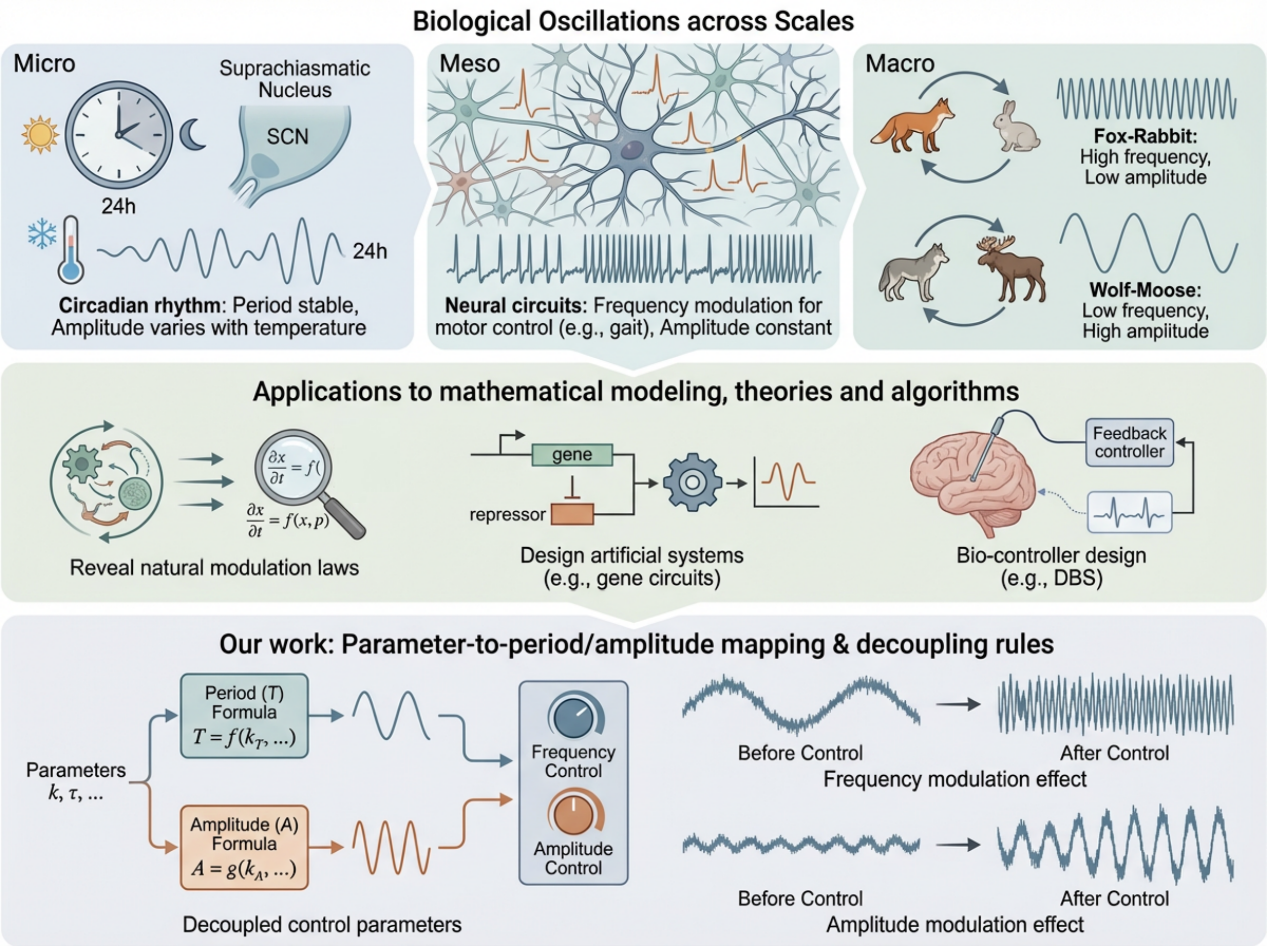
(i) Theory and Algorithms for Frequency and Amplitude Modulation

Frequency and amplitude are significant properties of biological oscillations that require precise regulation for functional performance. We address the challenge of designing biological systems with tunable frequency and amplitude. By applying dynamical bifurcation theory, we have uncovered a universal mechanism for frequency-amplitude decoupling and developed efficient strategies for their modulation. (Nature Communications 2021; Physical Review Letters 2023)
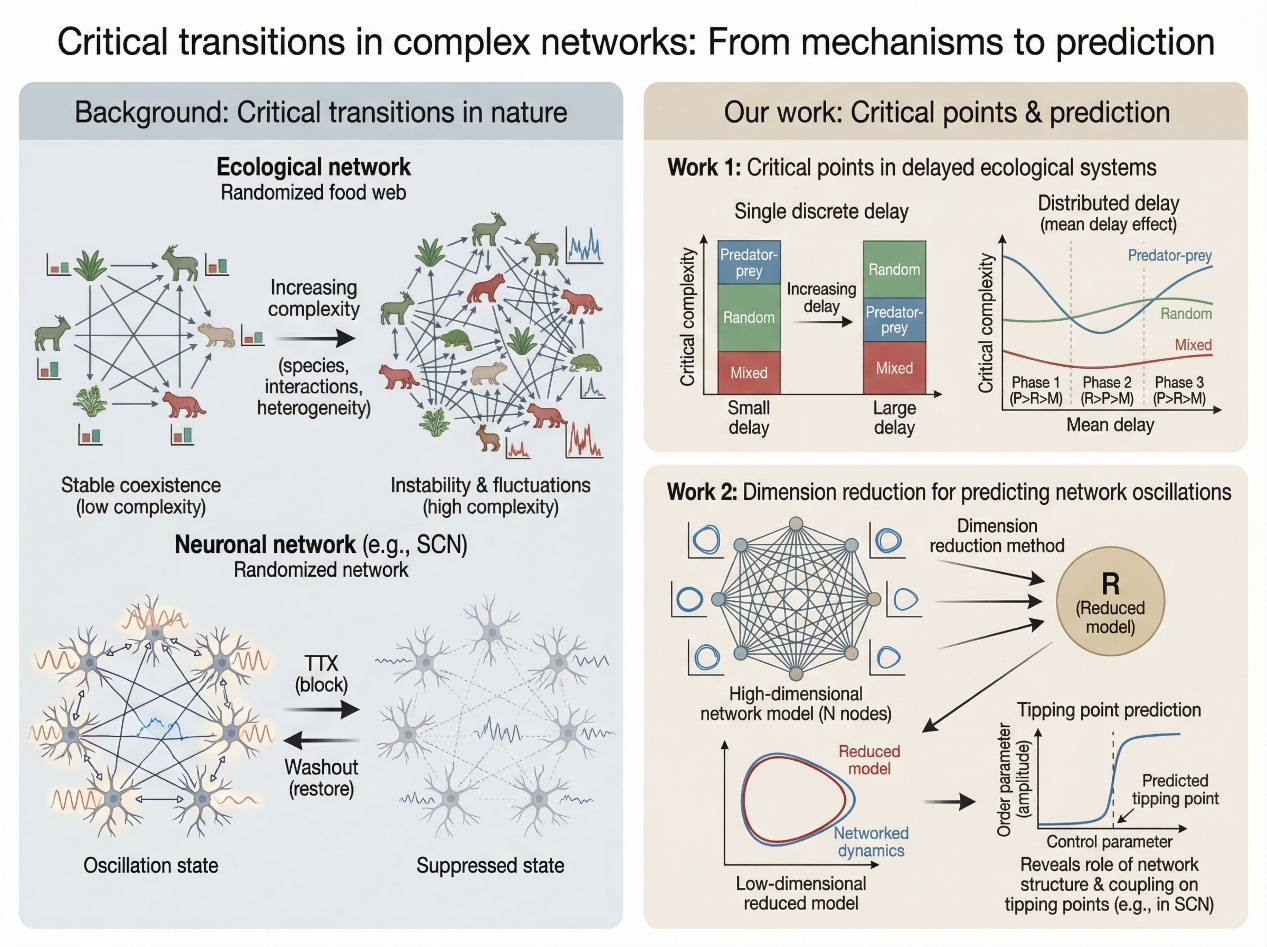
(ii) Analysis and Prediction of Critical Points in the Functional Emergence of Complex Systems

Functions of complex systems typically emerge from multi-scale coupling and complex interactions among individuals. Therefore, accurately predicting the critical points of such emergence and understanding their relationships with system parameters and network structures are of great significance. We have revealed a novel stability hierarchy induced by time delays in complex ecological systems. Furthermore, we have established an analytical framework and theory regarding the emergence of collective oscillations in multi-timescale complex oscillatory systems. (Physical Review Research 2023; PNAS Nexus 2025; SIADS 2026)
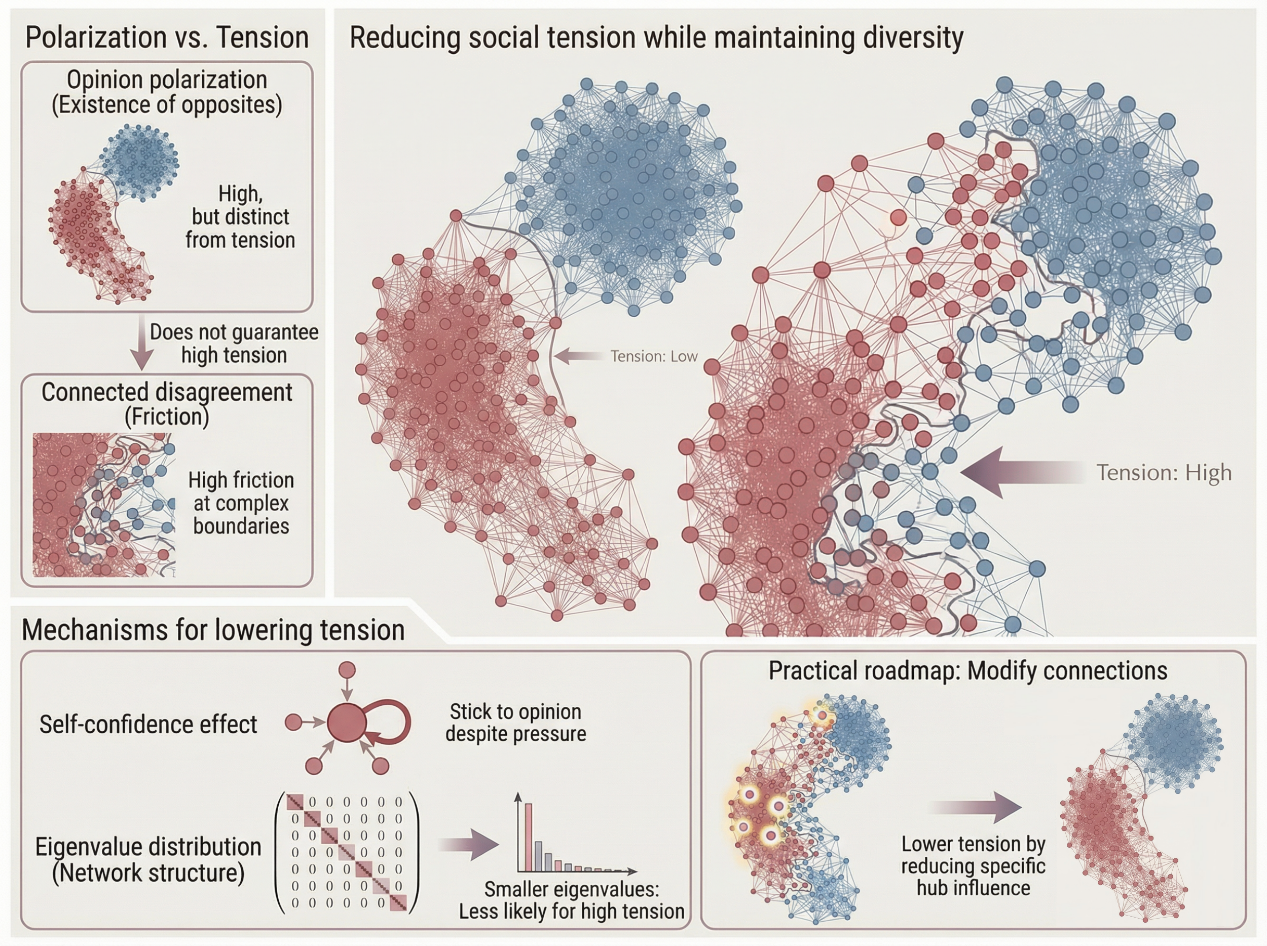
(iii) Evolution and Quantification of Spatiotemporal Pattern Complexity in Complex Systems

The evolution of microbial communities and the propagation of opinions in social systems often give rise to complex spatiotemporal patterns. We have established quantitative metrics for the boundary complexity between groups with distinct attributes. Furthermore, by employing methods such as bifurcation theory, we have uncovered the mechanisms governing their evolution and highlighted the critical role of network structures in this process. These findings provide a theoretical foundation for achieving 'harmony in diversity' in social systems. (Physical Review E, Letter 2026)
Selected Publications 

  1. Xuzhe Qian, Bo-Wei Qin*, Huaiping Zhu, Wei Lin*. Opinion polarization and its connected disagreement: Modeling and modulation. Physical Review E (Letter) 113, L012301 (2026).

https://phys.org/news/2026-01-differences-mathematical-social-friction-consensus.html

  1. Shuzhang, Bo-Wei Qin*, Kwok-wai Chung, Antonio Algaba, Alejandro J. Rodríguez-Luis. High-order approximations of the canard explosion in a delayed van der Pol system. SIAM Journal on Applied Dynamical Systems 25, 279-303 (2026).

  2. Bo-Wei Qin#, Wenbo Sheng#, Xuzhe Qian, Jürgen Kurths, Alan Hastings, Ying-Cheng Lai*, Wei Lin*. Reordered hierarchical complexity in ecosystems with delayed interactions. PNAS Nexus 4, pgaf214 (2025).

  3. Yi Cao#, Zefeng Zhang#, Bo-Wei Qin, Weihui Sang, Honghong Li, Tinghao Wang, Feixia Tan, Yang Gan, Xumeng Zhang*, Tao Liu*, Du Xiang*, Wei Lin, Qi Liu. Physical reservoir computing using van der Waals ferroelectrics for acoustic keywords spotting. ACS Nano 18, 23265-23276 (2024).

  4. Bo-Wei Qin*, Wei Lin. Tipping point for pulsatile oscillations in dynamical networks. Physical Review Research 5, 043209 (2023). 

  5. Zhaoyue Zhong, Wei Lin*, Bo-Wei Qin*Modulating biological rhythms: A noncomputational strategy harnessing nonlinearity and decoupling frequency and amplitude. Physical Review Letters 131, 138401 (2023). 

  6. Bo-Wei Qin*, Lei Zhao, Wei Lin*. A frequency-amplitude coordinator and its optimal energy consumption for biological oscillators. Nature Communications 12, 5894 (2021). 

  7. Bo-Wei Qin, Kwok-wai Chung, Antonio Algaba, Alejandro J. Rodríguez-Luis*. Asymptotic expansions for a degenerate canard explosion. Physica D 418, 132841 (2021).

  8. Bo-Wei Qin, Kwok-wai Chung, Antonio Algaba, Alejandro J. Rodríguez-Luis*. High-order approximation of heteroclinic bifurcations in truncated 2D-normal forms for the generic cases of Hopf-zero and nonresonant double Hopf singularities. SIAM Journal on Applied Dynamical Systems 20, 403-437 (2021).

  9. Bo-Wei Qin, Kwok-wai Chung, Antonio Algaba, Alejandro J. Rodríguez-Luis*. High-order analysis of canard explosion in the Brusselator equations. International Journal of Bifurcation and Chaos 30, 2050078 (2020).

  10. Bo-Wei Qin, Kwok-wai Chung, Antonio Algaba, Alejandro J. Rodríguez-Luis*. High-order study of the canard explosion in an aircraft ground dynamics model. Nonlinear Dynamics 100, 1079-1090 (2020).

  11.  Antonio Algaba, Kwok-wai Chung, Bo-Wei Qin, Alejandro J. Rodríguez-Luis*. Analytical approximation of the canard explosion in a van der Pol system with the nonlinear time transformation method. Physica D 406, 132384 (2020).

  12. Bo-Wei Qin, Kwok-wai Chung, Antonio Algaba, Alejandro J. Rodríguez-Luis*. High-order analysis of global bifurcations in a codimension-three Takens–Bogdanov singularity in reversible systems. International Journal of Bifurcation and Chaos 30, 2050017 (2020).

  13.  Antonio Algaba, Kwok-wai Chung, Bo-Wei Qin, Alejandro J. Rodríguez-Luis*. Computation of all the coefficients for the global connections in the Z2 -symmetric Takens-Bogdanov normal forms. Communications in Nonlinear Science and Numerical Simulations 81, 105012 (2019).

  14.  Antonio Algaba, Kwok-wai Chung, Bo-Wei Qin, Alejandro J. Rodríguez-Luis*. A nonlinear time transformation method to compute all the coefficients for the homoclinic bifurcation in the quadratic Takens–Bogdanov normal form. Nonlinear Dynamics 97, 979-990 (2019).

  15.  Antonio Algaba, Manuel Merino, Bo-Wei Qin, Alejandro J. Rodríguez-Luis*. Study of a dynamical system with a strange attractor and invariant tori. Physics Letters A 383, 1441-1449 (2019).

  16. Bo-Wei Qin, Kwok-wai Chung*, Alejandro J. Rodríguez-Luis, Mohamed Belhaq. Homoclinic-doubling and homoclinic-gluing bifurcations in the Takens-Bogdanov normal form with D4 symmetry. Chaos 28, 093107 (2018).

  17. Bo-Wei Qin, Kwok-wai Chung*, Abdelhak Fahsi, Mohamed Belhaq. On the heteroclinic connections in the 1:3 resonance problem. International Journal of Bifurcation and Chaos 26,1650143 (2016).

*Corresponding author#Contributed equally


time:2021-03-10 view:5567

Associate Research Professor, Ph.D. Supervisor


E-mail: boweiqin@fudan.edu.cn


Academic Sevice

Member of the Youth Committee, Society for Mathematical Biology, Chinese Mathematical Society

Member, Professional Committee on Synergistic Governance of Eco-environmental Complex Systems, Chinese Society for Environmental Sciences

Secretary-General, Shanghai Society for Nonlinear Science

Biography

Dr. Bo-Wei Qin is currently an associate research professor at Research Institute of Intelligent Complex System, Fudan University. He obtained his Ph.D. from the City University of Hong Kong in 2017. He holds several academic positions, including Secretary-General of the Shanghai Society for Nonlinear Science.

His research focuses on applied mathematics and complexity science, particularly applying bifurcation theory and efficient algorithms to the dynamics of genetic circuits, neural networks, ecological and social systems. He has published over 20 papers in top-tier journals such as PRL, Nature Communications, and SIAM ADS as the (co-)first or the (co-)corresponding author. He chaired three NSFC projects including a funding for National Excellent Young Scholars (only 14 young scholars in applied mathematics were rewarded in 2025).

Research Interests

Complex System, Nonlinear Science, Bifurcation Theory, Quantitative Biology, Computational Systems Biology

Education Experience

  • September 2012 – October 2017 Ph.D.Department of Mathematics (Advisor: Professor Kwok-wai Chung), City University of Hong Kong

  • September 2007 – June 2011 B.Sc.Department of Mathematics, City University of Hong Kong

Professional Experience:

  • December 2023 – Present Associate Research Professor, Research Institute of Intelligent Complex Systems, Fudan University

  • April 2022 – November 2023 (Young) Associate Research Professor, Research Institute of Intelligent Complex Systems, Fudan University

  • September 2019 – March 2022 Postdoctoral Research Fellow, School of Mathematical Sciences, Fudan University

  • May 2018 – December 2018 Visiting Scholar, Applied Mathematics, University of Seville

  • November 2017 – August 2019 Research Assistant, Department of Mathematics, City University of Hong Kong

Research Highlights

(i) Theory and Algorithms for Frequency and Amplitude Modulation

Frequency and amplitude are significant properties of biological oscillations that require precise regulation for functional performance. We address the challenge of designing biological systems with tunable frequency and amplitude. By applying dynamical bifurcation theory, we have uncovered a universal mechanism for frequency-amplitude decoupling and developed efficient strategies for their modulation. (Nature Communications 2021; Physical Review Letters 2023)

(ii) Analysis and Prediction of Critical Points in the Functional Emergence of Complex Systems

Functions of complex systems typically emerge from multi-scale coupling and complex interactions among individuals. Therefore, accurately predicting the critical points of such emergence and understanding their relationships with system parameters and network structures are of great significance. We have revealed a novel stability hierarchy induced by time delays in complex ecological systems. Furthermore, we have established an analytical framework and theory regarding the emergence of collective oscillations in multi-timescale complex oscillatory systems. (Physical Review Research 2023; PNAS Nexus 2025; SIADS 2026)

(iii) Evolution and Quantification of Spatiotemporal Pattern Complexity in Complex Systems

The evolution of microbial communities and the propagation of opinions in social systems often give rise to complex spatiotemporal patterns. We have established quantitative metrics for the boundary complexity between groups with distinct attributes. Furthermore, by employing methods such as bifurcation theory, we have uncovered the mechanisms governing their evolution and highlighted the critical role of network structures in this process. These findings provide a theoretical foundation for achieving 'harmony in diversity' in social systems. (Physical Review E, Letter 2026)

Selected Publications 

  1. Xuzhe Qian, Bo-Wei Qin*, Huaiping Zhu, Wei Lin*. Opinion polarization and its connected disagreement: Modeling and modulation. Physical Review E (Letter) 113, L012301 (2026).

https://phys.org/news/2026-01-differences-mathematical-social-friction-consensus.html

  1. Shuzhang, Bo-Wei Qin*, Kwok-wai Chung, Antonio Algaba, Alejandro J. Rodríguez-Luis. High-order approximations of the canard explosion in a delayed van der Pol system. SIAM Journal on Applied Dynamical Systems 25, 279-303 (2026).

  2. Bo-Wei Qin#, Wenbo Sheng#, Xuzhe Qian, Jürgen Kurths, Alan Hastings, Ying-Cheng Lai*, Wei Lin*. Reordered hierarchical complexity in ecosystems with delayed interactions. PNAS Nexus 4, pgaf214 (2025).

  3. Yi Cao#, Zefeng Zhang#, Bo-Wei Qin, Weihui Sang, Honghong Li, Tinghao Wang, Feixia Tan, Yang Gan, Xumeng Zhang*, Tao Liu*, Du Xiang*, Wei Lin, Qi Liu. Physical reservoir computing using van der Waals ferroelectrics for acoustic keywords spotting. ACS Nano 18, 23265-23276 (2024).

  4. Bo-Wei Qin*, Wei Lin. Tipping point for pulsatile oscillations in dynamical networks. Physical Review Research 5, 043209 (2023). 

  5. Zhaoyue Zhong, Wei Lin*, Bo-Wei Qin*Modulating biological rhythms: A noncomputational strategy harnessing nonlinearity and decoupling frequency and amplitude. Physical Review Letters 131, 138401 (2023). 

  6. Bo-Wei Qin*, Lei Zhao, Wei Lin*. A frequency-amplitude coordinator and its optimal energy consumption for biological oscillators. Nature Communications 12, 5894 (2021). 

  7. Bo-Wei Qin, Kwok-wai Chung, Antonio Algaba, Alejandro J. Rodríguez-Luis*. Asymptotic expansions for a degenerate canard explosion. Physica D 418, 132841 (2021).

  8. Bo-Wei Qin, Kwok-wai Chung, Antonio Algaba, Alejandro J. Rodríguez-Luis*. High-order approximation of heteroclinic bifurcations in truncated 2D-normal forms for the generic cases of Hopf-zero and nonresonant double Hopf singularities. SIAM Journal on Applied Dynamical Systems 20, 403-437 (2021).

  9. Bo-Wei Qin, Kwok-wai Chung, Antonio Algaba, Alejandro J. Rodríguez-Luis*. High-order analysis of canard explosion in the Brusselator equations. International Journal of Bifurcation and Chaos 30, 2050078 (2020).

  10. Bo-Wei Qin, Kwok-wai Chung, Antonio Algaba, Alejandro J. Rodríguez-Luis*. High-order study of the canard explosion in an aircraft ground dynamics model. Nonlinear Dynamics 100, 1079-1090 (2020).

  11.  Antonio Algaba, Kwok-wai Chung, Bo-Wei Qin, Alejandro J. Rodríguez-Luis*. Analytical approximation of the canard explosion in a van der Pol system with the nonlinear time transformation method. Physica D 406, 132384 (2020).

  12. Bo-Wei Qin, Kwok-wai Chung, Antonio Algaba, Alejandro J. Rodríguez-Luis*. High-order analysis of global bifurcations in a codimension-three Takens–Bogdanov singularity in reversible systems. International Journal of Bifurcation and Chaos 30, 2050017 (2020).

  13.  Antonio Algaba, Kwok-wai Chung, Bo-Wei Qin, Alejandro J. Rodríguez-Luis*. Computation of all the coefficients for the global connections in the Z2 -symmetric Takens-Bogdanov normal forms. Communications in Nonlinear Science and Numerical Simulations 81, 105012 (2019).

  14.  Antonio Algaba, Kwok-wai Chung, Bo-Wei Qin, Alejandro J. Rodríguez-Luis*. A nonlinear time transformation method to compute all the coefficients for the homoclinic bifurcation in the quadratic Takens–Bogdanov normal form. Nonlinear Dynamics 97, 979-990 (2019).

  15.  Antonio Algaba, Manuel Merino, Bo-Wei Qin, Alejandro J. Rodríguez-Luis*. Study of a dynamical system with a strange attractor and invariant tori. Physics Letters A 383, 1441-1449 (2019).

  16. Bo-Wei Qin, Kwok-wai Chung*, Alejandro J. Rodríguez-Luis, Mohamed Belhaq. Homoclinic-doubling and homoclinic-gluing bifurcations in the Takens-Bogdanov normal form with D4 symmetry. Chaos 28, 093107 (2018).

  17. Bo-Wei Qin, Kwok-wai Chung*, Abdelhak Fahsi, Mohamed Belhaq. On the heteroclinic connections in the 1:3 resonance problem. International Journal of Bifurcation and Chaos 26,1650143 (2016).

*Corresponding author#Contributed equally