
| 秦伯韡 (长聘)副研究员 博士生导师 复旦大学智能复杂体系基础理论与关键技术实验室 (长聘)副研究员 上海人工智能实验室 双聘青年研究员 社会兼职: 中国工业与应用数学学会数学生命科学专业委员会副秘书长、常务委员 中国数学会生物数学专委会青年工作委员会委员 中国环境科学学会生态环境复杂系统协同治理专委会委员 上海市非线性科学研究会第八届秘书长 E-mail: boweiqin@fudan.edu.cn 个人主页:秦伯韡 中文主页--首页 博士后招聘: 诚聘应用数学/物理学/系统科学/智能科学与技术博士后多名,欢迎加入团队!详情请发邮件垂询,并附上个人简历(长期有效)。 |

个人简介
秦伯韡,国家优青(数学学科),2011年和2017年在香港城市大学数学系分获学士和博士学位,之后在复旦大学数学科学学院任职博士后。2022年至今在复旦大学智能复杂体系基础理论与关键技术实验室担任副研究员。同时担任中国工业与应用数学学会数学生命科学专业委员会副秘书长及常务委员、中国数学会生物数学专委会青年工作委员会委员、中国环境科学学会生态环境复杂系统协同治理专委会委员和上海市非线性科学研究会秘书长。长期致力于应用数学和复杂性科学研究,聚焦分岔理论和数智算法在合成生物学、神经网络、生态及社会系统等复杂系统中的应用基础研究。以第一或通讯作者在Physical Review Letters、Nature Computational Science (Cover and Featured article)、Nature Communications、Journal of Theoretical Biology、SIAM Journal on Applied Dynamical Systems、Physica D、PNAS Nexus等期刊发表论文30余篇。主持国家自然科学基金3项,入选教育部脑科学前沿中心“珠峰”青年学者计划、复旦大学“卓学”优秀人才计划。
教育经历
2012.09-2017.10 香港城市大学 应用数学 博士
2007.09-2011.06 香港城市大学 计算数学 学士
研究领域和方向
应用数学、复杂性科学、数学生命科学、生物动力系统、人工智能、集成电路、智能电力系统
对复杂系统研究感兴趣的老师同学请戳:
系统生物学系列讲座第二十七期-复杂生物系统的数学模型与调控理论
科研进展
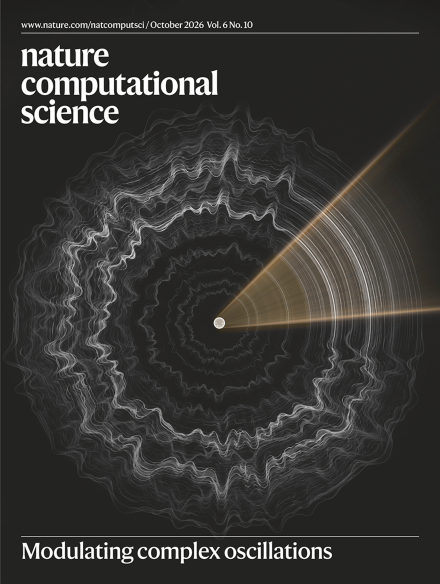
潜在属性驱动的复杂系统逆向设计、调控和参数反演理论与算法:在许多场景中,需要通过逆向设计、调控复杂生命和工程系统使其达到特定的动力学状态。有别于经典基于时间轨迹跟踪的思路,我们提出了基于潜在属性(如振荡的周期、振幅和相位)的设计和调控原创概念、理论与算法。(Nature Computational Science 2026, Cover of the October issue, Featured article, News & Views @ Nature Computational Science)
复杂系统调频调幅理论与算法:频率振幅是生物振荡的重要特征,需要维持在合适的范围以实现特定的功能。因此,需要合理设计生物系统以实现调频调幅功能。我们利用动力学分岔理论揭示了普适的频率振幅解耦机制,并建立了高效的调控策略。(Nature Communications 2021; Physical Review Letters 2023; Nature Computational Science 2026; Journal of Theoretical Biology 2027)

复杂系统功能涌现的临界点分析与预测:复杂系统功能通常在多尺度耦合和个体复杂的交互作用下涌现,准确地预测涌现临界点及其与系统关键参数、网络结构等重要属性间的关系有重要的科学价值。我们揭示了复杂生态系统由时滞诱导的稳定性新排序。此外,还建立了多时间尺度、复杂振荡系统的群体振荡涌现的分析框架和理论。(Physical Review Research 2023; PNAS Nexus 2025; SIADS 2026)

复杂系统时空斑图复杂度的演化与量化:微生物群落的演化、社会群体意见的传播都会形成复杂的时空斑图,我们建立了不同属性群体间的边界复杂度量化指标,并利用分岔理论等方法揭示了其演化规律及网络结构在其中的重要作用。为社会系统实现“和而不同”提供了理论支撑。(Physical Review E, Letter 2026)

代表性论文
Junjie Lai, Wei Lin, Bo-Wei Qin*, Modulating frequency and amplitude of discrete-time biological oscillations, Journal of Theoretical Biology, [2027], 638:112640.
Yutong Cai#, Zhaoyue Zhong#, Zefeng Zhang, Bo-Wei Qin*, Wei Lin*, Modulatability of complex oscillators, Nature Computational Science, [2026], 6:1100-1113.
Xuzhe Qian, Bo-Wei Qin*, Huaiping Zhu, Wei Lin*, Opinion polarization and its connected disagreement: Modeling and modulation, Physical Review E, [2026], 113(1): L012301.
Shuzhang, Bo-Wei Qin*, Kwok-wai Chung, Antonio Algaba, Alejandro J. Rodríguez-Luis, High-order approximations of the canard explosion in a delayed van der Pol system, SIAM Journal on Applied Dynamical Systems, [2026], 25: 279-303.
Bo-Wei Qin#, Wenbo Sheng#, Xuzhe Qian, Jürgen Kurths, Alan Hastings, Ying-Cheng Lai*, Wei Lin*, Reordered hierarchical complexity in ecosystems with delayed interactions, PNAS Nexus, [2025], 4: pgaf214.
Yi Cao, Zefeng Zhang, Bo-Wei Qin, Weihui Sang, Honghong Li, Tinghao Wang, Feixia Tan, Yang Gan, Xumeng Zhang*, Tao Liu*, Du Xiang*, Wei Lin, Qi Liu, Physical reservoir computing using van der Waals ferroelectrics for acoustic keywords spotting, ACS Nano, [2024], 18: 23265-23276.
Bo-Wei Qin*, Wei Lin, Tipping point for pulsatile oscillations in dynamical networks, Physical Review Research, [2023], 5: 043209.
Zhaoyue Zhong, Wei Lin*, Bo-Wei Qin*, Modulating biological rhythms: A noncomputational strategy harnessing nonlinearity and decoupling frequency and amplitude, Physical Review Letters, [2023], 131: 138401.
Bo-Wei Qin*, Lei Zhao, Wei Lin*, A frequency-amplitude coordinator and its optimal energy consumption for biological oscillators, Nature Communications, [2021], 12: 5894.
Bo-Wei Qin, Kwok-wai Chung, Antonio Algaba, Alejandro J. Rodríguez-Luis*, Asymptotic expansions for a degenerate canard explosion, Physica D, [2021], 418: 132841.
Bo-Wei Qin, Kwok-wai Chung, Antonio Algaba, Alejandro J. Rodríguez-Luis*, High-order approximation of heteroclinic bifurcations in truncated 2D-normal forms for the generic cases of Hopf-zero and nonresonant double Hopf singularities, SIAM Journal on Applied Dynamical Systems, [2021], 20: 403-437.
Bo-Wei Qin, Kwok-wai Chung, Antonio Algaba, Alejandro J. Rodríguez-Luis*, High-order analysis of canard explosion in the Brusselator equations, International Journal of Bifurcation and Chaos, [2020], 30: 2050078.
Bo-Wei Qin, Kwok-wai Chung, Antonio Algaba, Alejandro J. Rodríguez-Luis*, High-order study of the canard explosion in an aircraft ground dynamics model, Nonlinear Dynamics, [2020], 100: 1079-1090.
Antonio Algaba, Kwok-wai Chung, Bo-Wei Qin, Alejandro J. Rodríguez-Luis*, Analytical approximation of the canard explosion in a van der Pol system with the nonlinear time transformation method, Physica D, [2020], 406: 132384.
Bo-Wei Qin, Kwok-wai Chung, Antonio Algaba, Alejandro J. Rodríguez-Luis*, High-order analysis of global bifurcations in a codimension-three Takens–Bogdanov singularity in reversible systems, International Journal of Bifurcation and Chaos, [2020], 30: 2050017.
Antonio Algaba, Kwok-wai Chung, Bo-Wei Qin, Alejandro J. Rodríguez-Luis*, Computation of all the coefficients for the global connections in the Z2-symmetric Takens-Bogdanov normal forms, Communications in Nonlinear Science and Numerical Simulations, [2019], 81: 105012.
Antonio Algaba, Kwok-wai Chung, Bo-Wei Qin, Alejandro J. Rodríguez-Luis*, A nonlinear time transformation method to compute all the coefficients for the homoclinic bifurcation in the quadratic Takens–Bogdanov normal form, Nonlinear Dynamics, [2019], 97: 979-990.
Antonio Algaba, Manuel Merino, Bo-Wei Qin, Alejandro J. Rodríguez-Luis*, Study of a dynamical system with a strange attractor and invariant tori, Physics Letters A, [2019], 383: 1441-1449.
Bo-Wei Qin, Kwok-wai Chung*, Alejandro J. Rodríguez-Luis, Mohamed Belhaq, Homoclinic-doubling and homoclinic-gluing bifurcations in the Takens-Bogdanov normal form with D4 symmetry, Chaos, [2018], 28: 093107.
Bo-Wei Qin, Kwok-wai Chung*, Abdelhak Fahsi, Mohamed Belhaq, On the heteroclinic connections in the 1:3 resonance problem, International Journal of Bifurcation and Chaos, [2016], 26: 1650143.
(*为通讯作者,#为同等贡献)